
When your branding strategy calls for vibrant color and you need to make a big impact on a budget, screen printing is the undisputed champion. This time-tested method is renowned for its ability to produce a vibrant logo with exceptional color accuracy, making it the go-to choice for large-scale promotional campaigns and corporate events. This guide explains the screen printing process and why it is the most effective solution for bulk notebook printing.
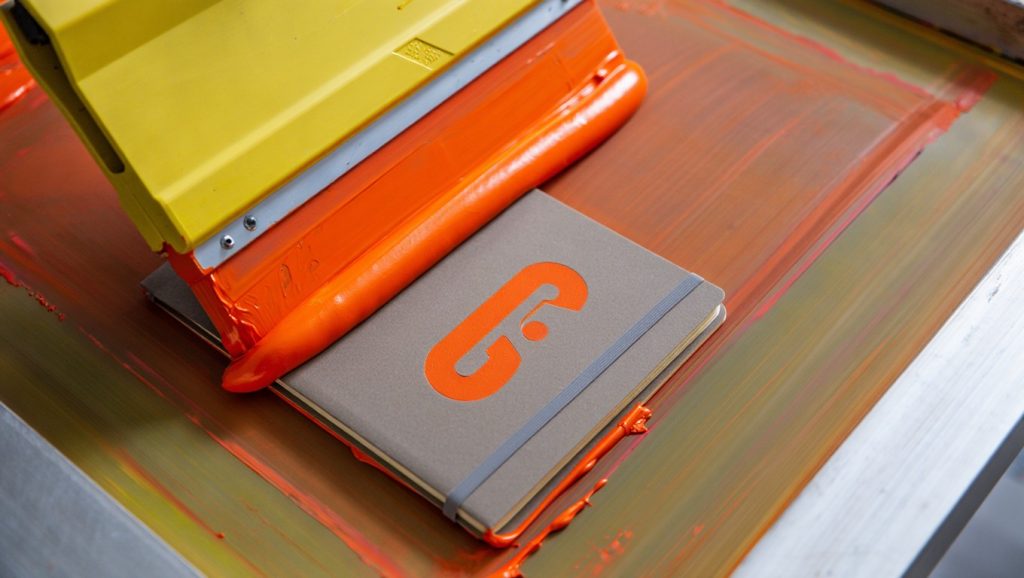
The Screen Printing Process: Ink, Mesh, and Squeegee
Screen printing, also known as silk screen printing, is a classic stenciling technique. The process involves pushing ink through a mesh screen that has been selectively blocked to create a specific design. Here’s a simplified breakdown:
- Screen Preparation: A fine mesh screen is stretched tightly over a frame. A light-sensitive emulsion is applied to the screen, which is then exposed to UV light with your logo artwork placed on top. The light hardens the emulsion everywhere except where the logo is, which remains soft.
- Stencil Creation: The screen is washed, and the soft, unexposed emulsion (the logo area) rinses away, leaving a clear stencil of your design within the hardened mesh.
- Ink Application: The screen is placed directly onto the notebook cover. A line of thick ink is applied to the top of the screen, and a squeegee is used to pull the ink firmly and evenly across the stencil. The ink passes through the open areas of the mesh, transferring your logo directly onto the product.
- Curing: The printed notebook is passed through a high-heat dryer. This crucial step cures the ink, ensuring it forms a strong, resilient bond with the surface. Once cured, the durable ink has a distinct hand-feel; it sits on top of the material with a smooth, slightly raised texture, adding a subtle tactile dimension to the visual design.
The Power of Spot Color: Perfect PMS Color Match
One of screen printing’s most significant advantages is its ability to achieve a near-perfect PMS color match. The Pantone Matching System (PMS) is a standardized color library used by designers and printers to ensure brand color consistency. Unlike digital printing, which uses a four-color (CMYK) mix to approximate colors, screen printing uses pre-mixed “spot colors.”
This means the ink is mixed to your exact PMS specification before it is applied. For corporations with strict brand guidelines, this is non-negotiable. It guarantees that the specific shade of red, blue, or green in your logo is precisely replicated every single time, maintaining brand integrity across all promotional materials.
A Note on Pricing & Color Complexity: Screen printing is typically priced per color. Each color in your design requires its own screen and setup, so 1 or 2-color designs are the most budget-friendly. For logos with 5+ colors or photographic images, Full-Color Digital Printing often becomes a more cost-effective solution.
Why It’s the Go-To for Bulk Orders and Corporate Events
Screen printing is a setup-intensive process. Creating the screens and mixing the inks takes time, which accounts for the initial setup costs. However, once the setup is complete, the process of printing each individual notebook is incredibly fast and efficient. This leads to a key economic advantage:
The cost per unit decreases significantly as the order quantity increases.
This inverse cost relationship makes screen printing the most cost-effective method for bulk notebook printing. For large corporate events, trade shows, or company-wide giveaways where hundreds or thousands of notebooks are needed, no other method provides the same combination of vibrant color, durability, and affordability at scale.
Ideal Materials and Large Imprint Areas
Screen printing works best on flat, non-porous surfaces where the ink can be applied evenly and cure properly. Furthermore, it is ideal for designs that require large imprint areas. Unlike other methods that are often restricted to a smaller corner placement, screen printing can easily cover a significant portion of the notebook’s cover, offering maximum brand visibility.
| Material | Why It Works Well |
|---|---|
| Plastic Covers | The smooth, non-porous surface of plastic is perfect for screen printing. The ink adheres strongly, resulting in a bright, opaque, and durable logo. This is common on budget-friendly spiral notebooks. |
| Hard Covers (Coated) | Most hard-cover notebooks have a coated paper or vinyl finish. This provides an excellent, uniform surface for the ink to bond with, creating a sharp and vibrant logo that stands out. |
| Spiral Notebooks | Because the covers can be printed while they are flat (before the spiral binding is inserted), screen printing is an efficient and popular choice for this style of notebook, often used for educational and event giveaways. |
Conclusion
For achieving a vibrant logo with perfect color accuracy across a large volume of products, screen printing is the superior choice. Its use of durable ink and the precision of PMS color match ensure your brand looks its best, while its cost-effectiveness at scale makes it the smartest option for bulk notebook printing. When brand consistency and budget are top priorities, the classic silk screen method delivers unmatched value.
See Our Offer of Screen Printed Notebooks
-

Recycled & Eco Notebooks, Spiral Bound Notebooks
Price from: $2.72Select options This product has multiple variants. The options may be chosen on the product page -

Hardcover Notebooks, Spiral Bound Notebooks
Price from: $2.47Select options This product has multiple variants. The options may be chosen on the product page -

Hardcover Notebooks, Spiral Bound Notebooks
Price from: $3.72Select options This product has multiple variants. The options may be chosen on the product page -
 Price from: $2.90Select options This product has multiple variants. The options may be chosen on the product page


